GoHighLevel vs ClickFunnels 2026: Avoid a Devastating Choice. Which One Is Proven To Fit Your Business?
By the Workflow Dynamics Research Team. Last updated August 12, 2026. Pricing verified against official sources on August 12, 2026.
Quick Answer
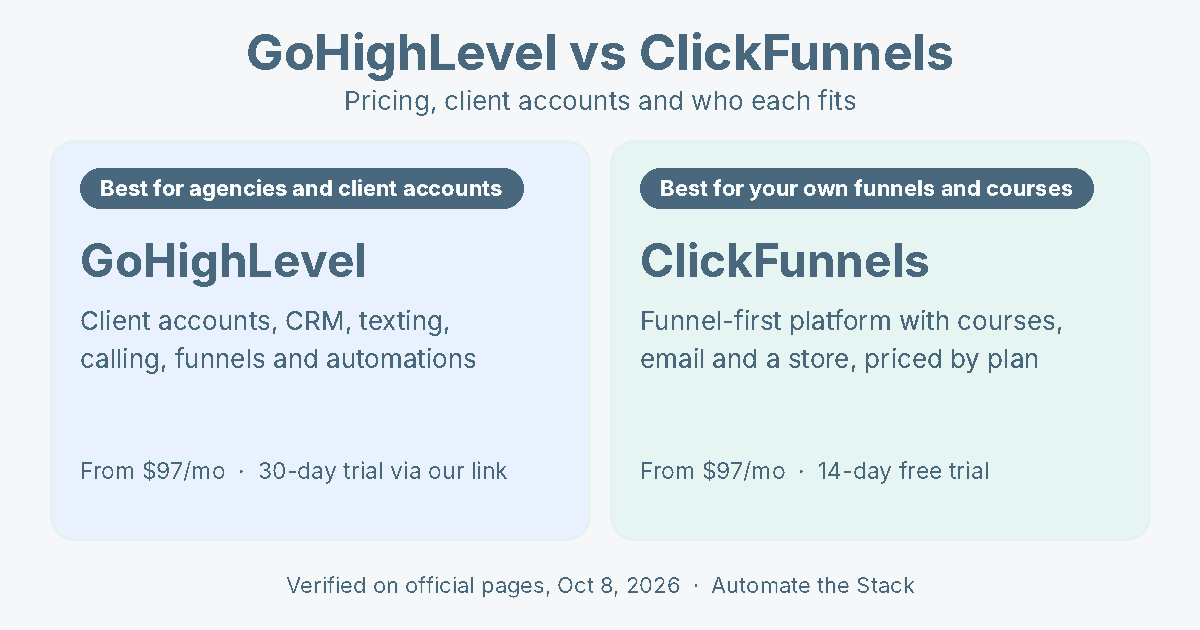
GoHighLevel and ClickFunnels both start at $97/month, but they solve different problems. ClickFunnels is a funnel builder first — it’s faster to learn and better suited to a single offer with a single sales sequence. GoHighLevel is a full client-management system built around a CRM, so it costs less once you need contact management, SMS, and calling instead of piecing those together with separate tools. Solo operators running one offer generally do better on ClickFunnels; agencies and businesses managing multiple clients or a growing contact list generally do better on GoHighLevel. The pricing gap looks identical at the entry tier and widens sharply once either platform’s native tools stop being enough on their own.
Some links on this website may be affiliate links, which can yield a commission for us at no additional cost to you.
GoHighLevel VS ClickFunnels What Each Product Is
GoHighLevel is an all-in-one CRM and marketing operations platform built primarily for agencies and service businesses that manage relationships with multiple clients or a large contact list. At its core, GoHighLevel is a customer relationship management system: every plan, starting at the $97/month Starter tier, bundles a CRM, email marketing, SMS messaging, and a calendar/booking system into the base subscription. Funnel and website building sit on top of that CRM foundation rather than being the product’s central purpose. This ordering matters for how the platform behaves in practice — a lead that fills out a GoHighLevel funnel form lands directly inside a contact record with a full activity history, without needing a separate integration to a CRM or email tool. Agencies use GoHighLevel to run entire client operations from one login: pipelines, automated follow-up sequences, two-way SMS conversations, appointment booking, reputation management, and — at the higher tiers — the ability to resell the platform itself under their own brand. The tradeoff for that breadth is a steeper learning curve; new users typically need two to four weeks to get a GoHighLevel account fully configured and running the way they want.
ClickFunnels is a funnel builder first, built by marketers for marketers selling a specific offer through a specific sequence of pages. Its core strength is speed: a solo entrepreneur can go from blank account to a live, working sales funnel — landing page, order form, upsell, downsell, thank-you page — in a single afternoon, using drag-and-drop templates purpose-built for conversion. Every ClickFunnels plan, from the $97/month Launch tier up, includes unlimited funnels, unlimited pages, and unlimited visitor traffic, with no caps on the building blocks that make up a funnel. Where GoHighLevel treats the CRM as the foundation, ClickFunnels treats the funnel as the foundation and layers email marketing, a basic CRM, and course hosting on top, priced and scaled by contact count rather than bundled flat. That makes ClickFunnels the faster on-ramp for someone validating a single product or offer, but it also means the built-in CRM and email tools are lighter-weight than GoHighLevel’s, and businesses that outgrow them typically bolt on a dedicated CRM rather than expanding within ClickFunnels itself.
The practical difference shows up fastest in onboarding time. GoHighLevel’s breadth means a new account typically takes two to four weeks to configure properly — pipelines, automations, calendar settings, and sub-account structure all need setup before the platform runs the way an agency wants. ClickFunnels’ narrower scope means a functioning funnel can go live the same day it’s built, which is exactly why solo operators and first-time product launchers gravitate toward it. That speed advantage narrows the longer a business runs, though, since ClickFunnels’ contact- and course-based limits mean revisiting the account structure again as volume grows — something GoHighLevel’s flat-CRM model avoids.
GoHighLevel VS ClickFunnels Feature Comparison
| Category | GoHighLevel | ClickFunnels | Best fit for |
|---|---|---|---|
| Core builder | Funnels, websites, forms, surveys — built on CRM data | Purpose-built funnel builder, unlimited funnels/pages/visitors on every tier | CF: single-offer speed. GHL: funnels tied to client records |
| CRM & contacts | Full CRM bundled into every tier, including Starter | Basic CRM included; scales/priced by contact volume | GHL: agencies managing many contacts. CF: light contact needs |
| Email marketing | Included, billed by usage ($0.675/1,000 sends) | Included, priced into contact-based plan tiers | Depends on send volume vs. contact volume |
| SMS & calling | Native two-way SMS and calling at Twilio-parity usage rates | No native SMS/calling; requires third-party integration | GHL: businesses that need texting/calling clients directly |
| Automation | Full workflow automation across CRM, funnels, and communication channels | Funnel-focused automation (email sequences, order triggers) | GHL: cross-channel automation. CF: funnel-specific sequences |
| Integrations | Native + Zapier; API access from Unlimited tier up | Native + Zapier; broad third-party marketing app ecosystem | Roughly comparable; depends on specific stack |
| Course hosting | Included in all tiers | Included, with hard course caps by tier (3–20) | CF: creators wanting a course cap that matches output. GHL: no course cap |
| White-label / resale | SaaS Mode at SaaS Pro tier ($497/mo) — resell as your own software | Not available — no white-label or resale option | GHL only, and only at the $497/mo tier |
| Support | Live chat/support scales with tier | Priority support at higher tiers | Roughly comparable at matching price points |
GoHighLevel VS ClickFunnels Feature-by-Feature Deep Dive
Core funnel/page builder. ClickFunnels wins on raw building speed for a single offer. Its templates are conversion-tested and narrowly focused, so a solo operator can launch a working funnel same-day. GoHighLevel’s builder is capable of the same output — landing pages, order forms, upsell flows — but it’s one module inside a larger system, so there’s more interface to learn before you get to your first published page. If the entire job is “build one funnel and sell one thing,” ClickFunnels gets there faster.
CRM and contact management. This is GoHighLevel’s clearest structural advantage. Every GoHighLevel tier, including the $97/month Starter plan, includes a full CRM with pipelines, contact records, and activity tracking as a first-class feature — not an add-on. ClickFunnels includes a CRM too, but it’s built to support the funnel, not to run client operations, and its depth (and cost) scales with contact count. An agency juggling dozens of client relationships will feel the difference within the first month.
Email marketing. Both platforms include email natively. GoHighLevel bills email usage separately at $0.675 per 1,000 sends regardless of tier, which keeps the base subscription price predictable but adds a variable cost. ClickFunnels folds email capacity into its contact-based tier structure, so the cost shows up as a tier upgrade rather than a line-item usage fee. Neither approach is objectively cheaper — it depends on whether your list is large-but-low-send or smaller-but-high-frequency.
SMS and native calling. GoHighLevel includes two-way SMS and calling functionality in every tier, billed at Twilio-parity usage rates ($0.014/minute for calls). This is a category ClickFunnels doesn’t compete in at all — there’s no native SMS or calling, so businesses that want to text or call leads directly from the platform need a third-party integration. For agencies running SMS-based follow-up (a common tactic for local-service and appointment-based businesses), this alone can decide the comparison.
Automation and workflows. GoHighLevel’s automation engine spans the entire platform — CRM stage changes, SMS sequences, email drips, appointment reminders, and funnel triggers can all live in one workflow. ClickFunnels’ automation is funnel-centric: email sequences and order-triggered actions tied to a specific funnel or product. If the automation need is “nurture this lead across every channel over time,” GoHighLevel’s system is built for that job. If it’s “send three follow-up emails after this specific purchase,” ClickFunnels handles it with less setup.
Integrations and API access. Both platforms connect to Zapier and maintain native integrations with common marketing tools. GoHighLevel gates full API access behind the Unlimited tier ($297/month) and above — the Starter tier has more limited API access. ClickFunnels’ integration ecosystem leans toward third-party marketing and e-commerce apps rather than CRM-adjacent tooling, reflecting its funnel-first design.
Course hosting. Both include course-building tools, but they diverge sharply on limits. ClickFunnels caps courses by tier — 3 on Launch, 6 on Scale, 10 on Optimize, 20 on Dominate — with no in-course quiz builder. GoHighLevel doesn’t impose a course-count cap. Creators planning a large course catalog will hit ClickFunnels’ ceiling well before GoHighLevel’s.
Scalability and multi-client management. This is where the two platforms’ underlying philosophies show most clearly. GoHighLevel’s sub-account structure is designed from the ground up for agencies managing multiple clients — each client gets an isolated environment, and at the SaaS Pro tier ($497/month), the entire platform can be rebranded and resold. ClickFunnels has no equivalent white-label or resale path; its “workspace” concept (up to 10 on Optimize) supports running multiple brands but not reselling the platform itself to clients.
Support. Support quality scales with tier on both platforms — live chat is standard, with priority support unlocked at higher price points. Neither platform has a meaningful support-quality edge at comparable price points based on available third-party feedback.
Reporting and analytics. GoHighLevel’s reporting spans the full customer journey — pipeline stage movement, campaign performance, call and SMS logs, and appointment show-rates all live in one dashboard, because they’re all generated inside the same CRM. ClickFunnels’ analytics are funnel-centric: conversion rate by step, A/B test performance, and revenue per funnel, available on every tier without a separate reporting add-on. For a business that needs to see “which funnel step is leaking conversions,” ClickFunnels’ reporting is more immediately useful. For a business that needs to see “how is this client relationship progressing across every channel,” GoHighLevel’s is the better fit.
Mobile access. Both platforms offer mobile apps, but GoHighLevel’s is the more complete of the two, reflecting the platform’s CRM-first design — agencies can manage conversations, review pipeline stages, and respond to leads from the mobile app without needing a desktop session. ClickFunnels’ mobile experience leans toward monitoring (checking funnel performance, order notifications) rather than full account management, consistent with its builder-first focus.
GoHighLevel VS ClickFunnels Pricing
GoHighLevel runs three tiers. Starter is $97/month ($81/month billed annually) and includes the full CRM, email, SMS, calendars, and funnel/website building, capped at three sub-accounts — enough for a solo operator or a very small agency. Unlimited is $297/month ($248/month annually) and removes the sub-account cap entirely, adding API access and the white-label desktop app so client-facing environments carry your branding, not GoHighLevel’s. SaaS Pro is $497/month ($414/month annually) and adds SaaS Mode — the ability to package, price, and resell the entire platform under your own brand, plus rebilling with markup on usage costs like SMS and calls. Every GoHighLevel tier bills email ($0.675 per 1,000 sends), SMS (Twilio-parity), and calls ($0.014/minute) separately from the subscription price.
ClickFunnels runs four tiers. Launch is $97/month ($81/month annually) and includes the full funnel builder — unlimited funnels, pages, and visitor traffic — with tighter caps on contacts, email sends, and courses (3). Scale is $197/month ($164/month annually) and raises those contact, email, and course (6) limits for growing operations. Optimize is $297/month ($248/month annually) and raises limits further — 10 courses, up to 10 workspaces for managing multiple brands or client accounts, and priority support. Dominate is $5,997/year only (no monthly option), built for high-volume operations needing the largest contact ceilings, 20 courses, and private onboarding. ClickFunnels’ native email and CRM capacity is priced into these contact-based tiers rather than billed separately by usage.
At the entry tier, the two platforms are priced identically: $97/month gets you into either one. The divergence starts as soon as either platform’s included tools stop covering what the business needs — GoHighLevel by usage fees layering onto a flat subscription, ClickFunnels by needing a tier upgrade or a bolt-on CRM once contact-based limits are hit.
Annual billing changes the math meaningfully on both sides. GoHighLevel’s annual rates ($81/$248/$414 per month, billed yearly) work out to roughly two months free compared to paying monthly — the same discount structure ClickFunnels uses on its Launch, Scale, and Optimize tiers ($81/$164/$248 per month annually). Neither platform’s annual discount changes which tier is the right fit; it only changes how much that tier costs once you’ve already decided. Businesses still validating product-market fit are generally better off on monthly billing for either platform, since switching tiers — or switching platforms entirely — is far easier without a prepaid annual commitment locking in the wrong plan.
GoHighLevel VS ClickFunnels Total Cost of Ownership
Sticker price alone understates ClickFunnels’ real cost for any business that outgrows its native contact/CRM tools — which tends to happen earlier than the pricing page suggests, since ClickFunnels’ CRM is built to support the funnel rather than run full client operations. A business on ClickFunnels Optimize ($297/month) that adds a separate, dedicated CRM once it outgrows the built-in tools typically pays roughly $100/month more for that CRM, bringing the realistic all-in cost to around $397/month.
GoHighLevel Unlimited, at a flat $297/month, already includes what that ClickFunnels setup is paying extra for — full CRM, SMS, and calling are bundled in from the Starter tier up, not added later. The gap between the two platforms at comparable capability, then, isn’t the identical $97 entry price — it’s a few hundred dollars a month once a business scales past a single funnel and starts needing real client-relationship infrastructure. Usage fees (email, SMS, calls) apply on top of GoHighLevel’s flat subscription regardless of tier, but for most small-to-mid-volume operations these run in the tens of dollars per month, not enough to close the gap created by ClickFunnels’ add-on CRM cost.
Worked out concretely: an agency on ClickFunnels Optimize paying $297/month, plus a standalone CRM at roughly $100/month, plus typical email/SMS tooling stacked separately, lands close to $400–450/month all-in once every function is covered. The same agency on GoHighLevel Unlimited pays $297/month flat, plus GoHighLevel’s own usage fees for email, SMS, and calls — which for a moderate-volume agency typically run $20–$50/month. That puts realistic all-in GoHighLevel cost around $320–350/month against ClickFunnels’ $400–450/month for equivalent functionality — a gap that widens further for agencies with heavier SMS or calling volume, since that’s a category ClickFunnels doesn’t offer natively at any price.
GoHighLevel VS ClickFunnels Third-Party Ratings
GoHighLevel holds a 4.2 out of 5 rating on G2 across 3,647 reviews, and a 4.6 out of 5 rating on Capterra across 1,247 reviews. The larger review volume on G2 reflects GoHighLevel’s broader agency user base; the gap between the two scores is common for platforms with a steep initial learning curve, where G2’s more feature-detailed review format tends to surface setup friction that shorter Capterra reviews don’t capture as heavily.
ClickFunnels holds a 4.6 out of 5 rating on G2 across 417 reviews, and a 4.5 out of 5 rating on Capterra across 666 reviews. ClickFunnels’ review volume is lower than GoHighLevel’s on both platforms, consistent with a narrower, funnel-focused user base rather than the broader agency and service-business audience GoHighLevel draws.
Read both platforms’ full review sets directly on G2 before deciding — aggregate scores compress a lot of nuance about specific use cases that the individual reviews spell out. The rating gap between the two platforms is smaller than the review-volume gap: ClickFunnels edges out GoHighLevel on average score by a few tenths of a point on G2, but GoHighLevel’s review base is nearly nine times larger, which generally makes its aggregate score the more statistically stable of the two. Neither difference is large enough to be a deciding factor on its own — the feature and pricing structure differences above matter more for most buying decisions than a 0.4-point rating gap. [VERIFY AT PUBLISH: confirm both G2/Capterra profile URLs resolve and review counts are current.]
GoHighLevel VS ClickFunnels Who Should Pick Which
Solo freelancers running one offer should pick ClickFunnels. If the entire business is a single product moving through a single funnel, ClickFunnels’ faster setup and lower learning curve get you to a live, sellable page faster, without paying for CRM and multi-client infrastructure you won’t use yet.
Agencies managing multiple clients should pick GoHighLevel. The bundled CRM, native SMS, and native calling — available from the $97/month Starter tier — replace tools an agency would otherwise stack separately, and the white-label resale option at SaaS Pro ($497/month) turns the platform into a revenue line rather than just a cost.
Scaling startups outgrowing a single-purpose tool should pick GoHighLevel. Once a business needs a full client system — CRM, multi-channel communication, and automation that spans more than one funnel — GoHighLevel is built for that job natively, where ClickFunnels would require bolting on separate tools to get the same coverage.
There’s no universal winner here, and any comparison claiming one is oversimplifying. The right pick depends on whether the job today is “sell one thing well” or “run a client operation.”
It’s also worth being specific about the middle ground: a freelancer who currently sells one offer but plans to take on retainer clients within the next year is closer to the “scaling startup” category than the “solo freelancer” category, even though the business looks identical today. The deciding question isn’t team size or current revenue — it’s whether the near-term roadmap includes managing more than one client relationship or contact list at once. If it does, starting on GoHighLevel avoids the mid-growth migration described in the objection-handling section below. If the roadmap is genuinely “perfect this one funnel and scale its traffic,” ClickFunnels’ narrower focus is an advantage, not a limitation.
Addressing the Objection: “I Don’t Need Another Tool Right Now”
It’s a reasonable instinct — adding a new platform mid-operation feels like disruption for its own sake, and “why are people leaving ClickFunnels” searches suggest plenty of businesses are asking the same question before they commit. But the pattern worth noticing is that businesses outgrowing a single-purpose funnel tool tend to switch anyway, eventually — the question isn’t whether, it’s when. Waiting until the built-in CRM or contact limits are already a daily bottleneck means migrating client data, automations, and workflows under time pressure, usually at the worst possible moment for the business, often mid-launch or mid-growth-spurt when there’s no slack in the schedule for a platform migration. Picking the tool that scales the first time — rather than the tool that’s fastest to start with — avoids that forced, rushed migration later.
If the business is genuinely staying single-offer indefinitely, that calculus doesn’t apply and ClickFunnels remains the right call — there’s no benefit to paying for CRM and multi-channel infrastructure that will sit unused. But “not needing another tool right now” and “won’t need one in six months” are different claims, and it’s worth being honest about which one actually describes the business’s trajectory. The businesses that end up switching platforms under pressure are almost always the ones that answered that question optimistically rather than realistically.
GoHighLevel VS ClickFunnels FAQ
Is GoHighLevel cheaper than ClickFunnels? At the entry tier, they’re priced identically — both start at $97/month. GoHighLevel becomes the cheaper option once a business needs CRM, SMS, and calling together, since those are bundled into every GoHighLevel tier rather than requiring a separate tool or a jump to a higher ClickFunnels tier.
Can ClickFunnels do what GoHighLevel does? Partially. ClickFunnels can build funnels and run basic email and CRM functions, but it has no native SMS or calling, and no white-label/resale option at any tier. For core funnel-building, the two are comparable; for full client-relationship management, GoHighLevel covers more ground natively.
Which platform is better for agencies? GoHighLevel, in most cases. The sub-account structure, native SMS/calling, and SaaS Mode resale option at the $497/month tier are built specifically for managing and monetizing multiple client relationships — a use case ClickFunnels doesn’t directly address.
Which platform is better for a solo offer or single product launch? ClickFunnels. The setup is faster, the learning curve is lower, and the platform’s entire design is oriented around a single, well-optimized funnel rather than broader client infrastructure a solo operator doesn’t need yet.
Does GoHighLevel have hidden fees? Not hidden, but usage-based: email, SMS, and calling are billed separately from the flat subscription price on every tier. These are documented, not concealed, but they do mean the advertised tier price isn’t the full monthly cost for active users.
Does ClickFunnels have hidden fees? The subscription price itself is flat, but ClickFunnels’ contact, email-send, and course limits mean many growing businesses face a forced tier upgrade sooner than expected, plus payment-processing fees on transactions.
What’s the real cost difference once a business scales? Roughly a few hundred dollars a month. A ClickFunnels Optimize setup ($297/month) that adds a separate CRM once it outgrows the built-in tools runs close to $397/month all-in, while GoHighLevel Unlimited covers the same ground natively at a flat $297/month.
Is the white-label / reseller option available on both platforms? No — this is GoHighLevel-only, and only at the SaaS Pro tier ($497/month). ClickFunnels has no white-label or platform-resale option at any tier.
Does switching from ClickFunnels to GoHighLevel (or the reverse) mean starting over? Largely yes for automations and workflows, since the two platforms don’t share a common export/import format for funnels or automations. Contact data can typically be exported and re-imported as a CSV, but funnel structures, email sequences, and CRM pipelines need to be rebuilt natively on the new platform. This is the practical cost behind the “switch later, at a worse time” pattern discussed above — it’s not just a subscription change, it’s a rebuild.
GoHighLevel VS ClickFunnels Risk-Reversal Terms
GoHighLevel offers a 14-day free trial with full feature access; a card is required at signup, and canceling before day 15 avoids any charge. There’s no separate money-back guarantee beyond the trial window. ClickFunnels offers a 14-day free trial plus a 30-day money-back guarantee stacked on top, giving 44 total risk-free days to test the platform before committing — a card is required at signup as well. Confirm both trial and cancellation terms directly on each platform’s signup page before entering payment details, since promotional trial lengths can vary by signup link.
GoHighLevel VS ClickFunnels Final Recommendation
Both platforms are priced identically at the entry point and diverge sharply from there based on what the business actually needs. ClickFunnels is the right call for a solo operator validating a single offer — it’s faster to launch and doesn’t force CRM overhead onto a business that doesn’t need it yet. GoHighLevel is the right call for agencies and any business managing more than one client relationship or a growing contact list, because its CRM, SMS, and calling are bundled into every tier rather than bolted on, which keeps costs flat as the business scales instead of climbing through separate tool subscriptions. The businesses most likely to regret their choice are the ones that pick based on the identical $97 sticker price alone, without accounting for which platform’s underlying structure — funnel-first or CRM-first — actually matches where the business is headed, not just where it is today.
Related Reading
For a deeper look at each platform individually, see our full GoHighLevel review and our full ClickFunnels review. For step-by-step setup guidance, see our GoHighLevel tutorial and our ClickFunnels tutorial.
Sales & Marketing Automation

We eliminate repetitive tasks by building smart, custom workflows that connect your apps and save your team hours every single day.
AI Content & Media Production

High-impact visual content and smart assets tailored for modern platforms, helping your brand stand out in a crowded digital space.
Data, Tools & Digital Infrastructure

Rock-solid technical foundations, cloud setups, and integrations designed to scale smoothly as your business grows.
Some links on this website may be affiliate links, which can yield a commission for us at no additional cost to you.